QUACKPOT + SPATCH · THE AVOCADO ADVENTURES

Good things take
a little time.

An orchard-to-toast story, two kitchen mysteries, and six shorts. QuackPot brings the questions. Spatch brings the patience.

Captioned videos · Transcripts below · Watch together with a grown-up

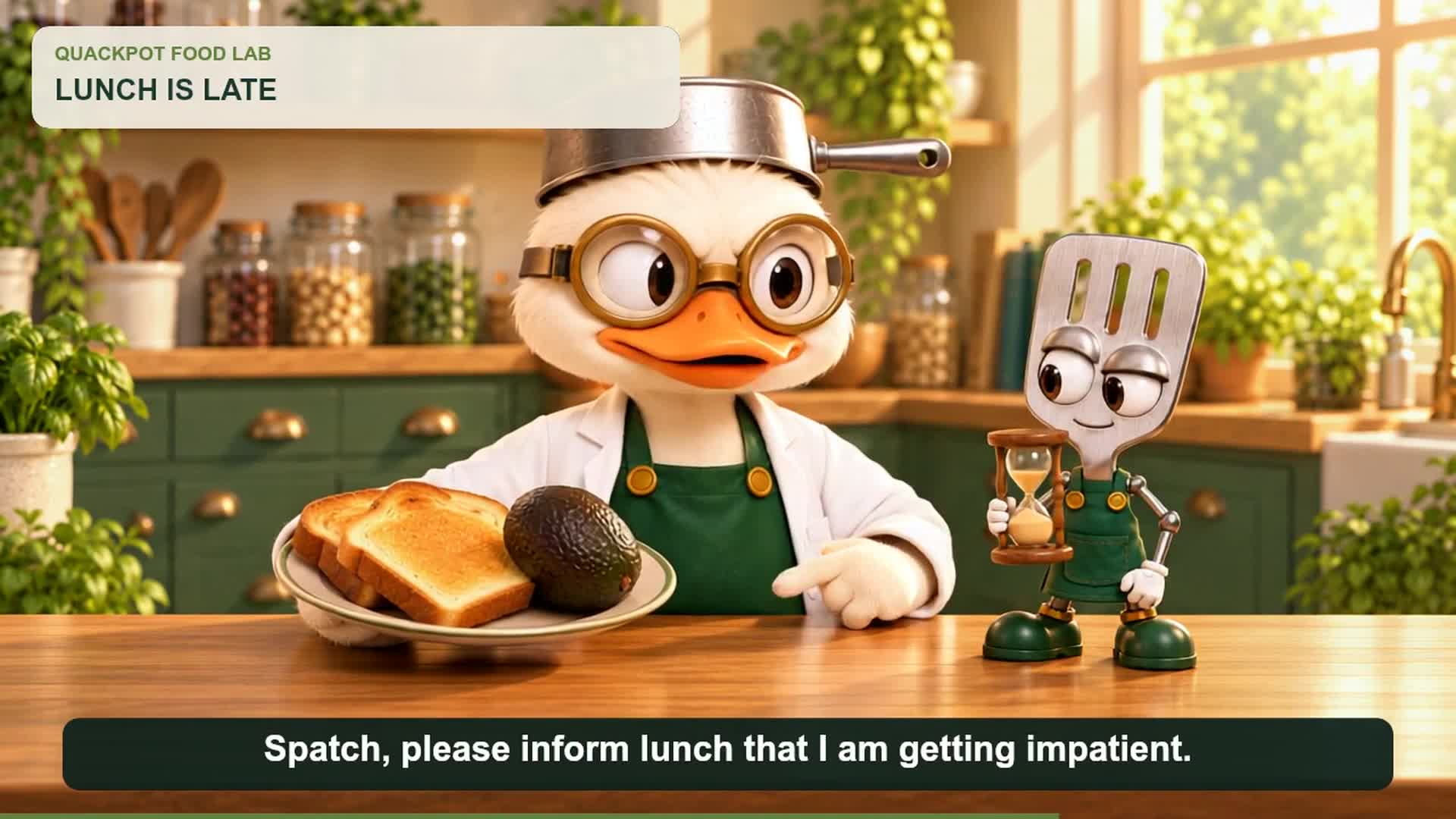
QuackPot and Spatch wait patiently—or not so patiently—for their avocado lunch.

FROM ORCHARD TO LUNCH

A story. Two mysteries.

About two minutes each.
Follow the fruit, then follow the clues.

An orchard-to-toast adventure · 2:07

The Great Avocado Wait

Follow an avocado from orchard to toast. QuackPot brings the impatience; Spatch brings the plan.

A question to share

How can an avocado be ready to pick but still need time before lunch?

Read the transcript

LUNCH IS LATE

Lab Members! My toast is ready. My avocado is not. Spatch, please inform lunch that I am getting impatient.

FOLLOW THE FRUIT

Every good lunch has a story. Ours begins in an avocado orchard. These fruits grow on trees, but here is the surprise: avocados normally soften and ripen after picking. Waiting under the tree will not finish my toast.

Ready to pick is not ready to eat

Growers harvest avocados when they are mature enough, while they are still firm. Then comes careful handling on the journey to the shop. Mature enough to pick and soft enough to eat are two different stops. Spatch has drawn me a map.

A LITTLE HELP

Back in the kitchen, Spatch has a paper bag and an apple. The apple gives off ethylene, a natural plant signal that can help the avocado ripen sooner. So the bag is a waiting room, not a lunch machine.

THE WAITING GAME

Ready? Not yet. Ready now? Still not yet. Spatch, I have checked the clock three times. Apparently, that does not count as three days.

How would you check?

Your turn, Lab Members. Would you judge every avocado by its skin color, or also check how gently it gives? Pick your clue.

Gentle pressure. No squeezing contest.

A ripe avocado gives a little under gentle pressure. Skin color can help with some varieties, but others stay green. Spatch is protecting this one from my championship squeeze. Gentle hands, QuackPot. Gentle hands.

SOME TIME LATER…

Some time later, our avocado is ready. An adult washes and cuts the fruit and removes the pit. We scoop, mash, and spread. Spatch adds the finishing flourish. I was planning a grand speech. I think lunch deserves the first word.

WORTH THE WAIT

From orchard to toast, this little fruit needed care and time. Spatch, you were right. A good lunch cannot always be hurried. Now, who left a green thumbprint on my notes? Ah. That would be me.

Sources & grown-up notes

Adults handle cutting and pit removal. The browning comparison is an illustration, not measured experimental data or a food-safety test.

What is the paper bag actually doing? · 1:42

The Ripening Clock

A paper bag and an apple start a new investigation into ripening, ethylene, and gentle hands.

A question to share

Would you use skin color alone to decide whether every avocado is ripe?

Read the transcript

THE PAPER-BAG MYSTERY

Spatch has put an apple beside my avocado in a paper bag. I have put on my most scientific expression. Is this a magic trick, or has my lunch joined a secret fruit club?

A natural plant signal

Meet ethylene: a gas that acts as a signal in plants. Ripening apples release it, and avocados respond to it. Our floating dots are a model of the gas. We cannot actually see little glowing messages around the fruit.

Why a paper bag helps

A paper bag can hold more of that ethylene near the avocado than open air does. An apple can add more. That may speed ripening, but it still takes time. Spatch, please cancel my thirty-second countdown.

CHECK AGAIN TOMORROW

Keep the bag at room temperature and check the fruit each day. Starting firmness and conditions change the timing. No exact countdown fits every avocado. My stopwatch is excellent at measuring seconds. Less excellent at negotiating with lunch.

Does a darker skin always mean ripe?

Prediction time. Two avocados have different skin colors. Must the darker one be ready first? Think about what else you would check.

Variety changes the clue

Not always! Varieties differ, and some ripe avocados stay green. Check for a little give with gentle pressure, without bruising the fruit. Once ripe, chilling slows further ripening. Spatch has retired my dramatic squeezing gloves.

CASE NOTES

Case notes: ethylene is a plant signal. A paper bag and an apple can help ripening along. Check daily and handle gently. Science can explain the wait. It cannot make my impatience an ingredient.

Sources & grown-up notes

Adults handle cutting and pit removal. The browning comparison is an illustration, not measured experimental data or a food-safety test.

Same avocado. A new color clue. · 1:58

The Brown Guacamole Mystery

Spatch follows the clues as green guacamole turns brown. Can a squeeze of lemon slow the change?

A question to share

How would you compare plain avocado with avocado mixed with lemon fairly?

Read the transcript

WHO CHANGED MY GUACAMOLE?

Lab Members! My mashed avocado was green. Now the top is turning brown. Spatch has arrived with a magnifying glass and a lemon. Excellent. A detective who brings the evidence and the garnish.

Cut cells meet oxygen

Cutting or mashing breaks open some of the avocado's cells. Oxygen from the air can then take part in reactions helped by an enzyme called polyphenol oxidase. That is a long name for a small helper in our browning mystery.

New brown compounds

Those reactions lead to new brown-colored compounds. This is enzymatic browning. It is different from the heat-driven browning in our toast case. No toaster is needed here. Spatch, you can put away the tiny fire extinguisher.

Can lemon slow it down?

Lemon or lime juice can slow browning, partly by making conditions more acidic. Limiting contact with air also helps. These steps slow the change; they do not make the avocado stay green forever. My garnish is useful, but it is not a time machine.

Make a fair comparison

Imagine two equal spoonfuls from the same avocado, kept under the same conditions. Add lemon juice to just one. Which would you predict will brown more slowly? Give Spatch your prediction.

Look for a difference over time

We expect the lemon-treated sample to brown more slowly. The difference can vary, so watch and record what happens. Our animation shows the idea, not measured results. A color clue alone cannot tell you whether stored food is safe.

CASE CLOSED… FOR LUNCH

An adult handles cutting and storing the food. Today's case notes: oxygen, enzymes, and time help explain the brown surface. Lemon can slow the change. Spatch has solved the mystery. I have solved the toast shortage. Teamwork!

Sources & grown-up notes

Adults handle cutting and pit removal. The browning comparison is an illustration, not measured experimental data or a food-safety test.

A LITTLE DISCOVERY

Six bites of curiosity.

Quick stories and science clues.
Watch on your favorite channel.

0:20

QuackPot cannot hurry lunch

Three clock checks. Still no lunch. Spatch has the patience QuackPot is missing.

Read the transcript

LUNCH IS LATE

Lab Members! My toast is ready. My avocado is not. Spatch, please inform lunch that I am getting impatient.

THE WAITING GAME

Ready? Not yet. Ready now? Still not yet. Spatch, I have checked the clock three times. Apparently, that does not count as three days.

0:32

An avocado's two kinds of ready

Ready to pick and ready to eat are two different stops on an avocado’s journey.

Read the transcript

FOLLOW THE FRUIT

Every good lunch has a story. Ours begins in an avocado orchard. These fruits grow on trees, but here is the surprise: avocados normally soften and ripen after picking. Waiting under the tree will not finish my toast.

Ready to pick is not ready to eat

Growers harvest avocados when they are mature enough, while they are still firm. Then comes careful handling on the journey to the shop. Mature enough to pick and soft enough to eat are two different stops. Spatch has drawn me a map.

0:28

Why the avocado paper-bag trick works

An apple, a paper bag, and a natural plant signal. Lunch still needs a little patience.

Read the transcript

THE PAPER-BAG MYSTERY

Spatch has put an apple beside my avocado in a paper bag. I have put on my most scientific expression. Is this a magic trick, or has my lunch joined a secret fruit club?

Why a paper bag helps

A paper bag can hold more of that ethylene near the avocado than open air does. An apple can add more. That may speed ripening, but it still takes time. Spatch, please cancel my thirty-second countdown.

0:29

A dark avocado is not the whole story

Some varieties stay green. QuackPot learns why color alone is not enough.

Read the transcript

Does a darker skin always mean ripe?

Prediction time. Two avocados have different skin colors. Must the darker one be ready first? Think about what else you would check.

Variety changes the clue

Not always! Varieties differ, and some ripe avocados stay green. Check for a little give with gentle pressure, without bruising the fruit. Once ripe, chilling slows further ripening. Spatch has retired my dramatic squeezing gloves.

0:31

Why guacamole turns brown

Cut cells meet oxygen, and an enzyme helps the browning mystery unfold.

Read the transcript

WHO CHANGED MY GUACAMOLE?

Lab Members! My mashed avocado was green. Now the top is turning brown. Spatch has arrived with a magnifying glass and a lemon. Excellent. A detective who brings the evidence and the garnish.

Cut cells meet oxygen

Cutting or mashing breaks open some of the avocado's cells. Oxygen from the air can then take part in reactions helped by an enzyme called polyphenol oxidase. That is a long name for a small helper in our browning mystery.

0:36

Lemon helps. It is not a time machine.

Citrus can slow browning. QuackPot discovers why it cannot stop the clock forever.

Read the transcript

Can lemon slow it down?

Lemon or lime juice can slow browning, partly by making conditions more acidic. Limiting contact with air also helps. These steps slow the change; they do not make the avocado stay green forever. My garnish is useful, but it is not a time machine.

Look for a difference over time

We expect the lemon-treated sample to brown more slowly. The difference can vary, so watch and record what happens. Our animation shows the idea, not measured results. A color clue alone cannot tell you whether stored food is safe.

A LITTLE TRANSPARENCY

Privacy & site information

This website does not include a sign-up form or use its own analytics or advertising trackers. Video and shop filters work in your browser without saving your choices. This is a resource site for parents, educators, and adult cooks; it does not offer child accounts.

Fonts are loaded from Google Fonts, which receives your connection information. Hosting and access are provided by ChatGPT Sites and are subject to that service's privacy practices.

Games open on the separate QuackPot game collection, hosted on ChatGPT Sites. Game progress is stored in your browser on that game address. The learning library also saves notebook entries, bookmarks, and activity progress in this browser on this website. It does not upload that notebook to a server. You can export it, import a previous notebook, or clear it using the notebook controls. Saves do not sync automatically across sites or devices. The launch and avocado videos play directly on this website. YouTube links, purchases and feedback open on YouTube or Payhip. Feedback is sent through Payhip’s contact form. Their own terms, privacy policies, and cookies apply when you visit them. No payment details are collected on this website.

The cookbook is a First Edition Preview. Please review the product information and supervision guidance on its shop page before purchasing.